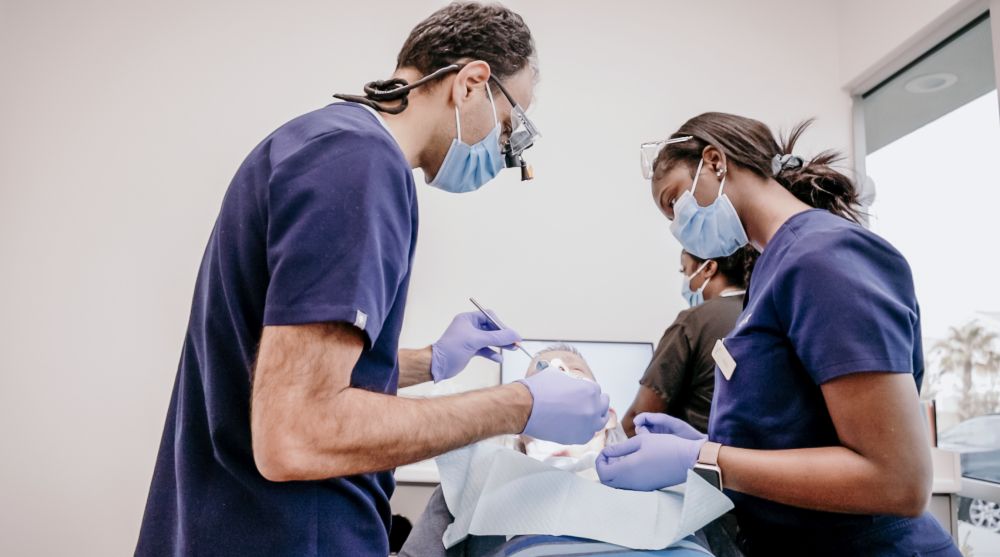
Our bodies don't heal in twenty four hours. So is Nubia's process rushing things? Like, how is this actually safe? I'm glad I have the opportunity to explain this. So there's a lot of planning that goes into this to make sure that it happens and that it happens in a predictable way. I wanna talk about long term. What if I get this done and spend all this money and it fails? You are gonna see so many different types of providers offering it and it doesn't mean that they have extensive experience. People are putting a lot of trust in us and, you know, that's something that we do not take lightly. I'm here with doctor Weber, an oral and maxillofacial surgeon who's worked in full mouth dental implants for almost a decade, helping restore thousands of smiles. And today, I'm putting him on the hot seat to answer the most unfiltered questions about the permanent teeth in twenty four hour process. Are you ready, doctor Weber? Give me your best shot. So typically, when you hear about full mouth dental implants, you expect a long process, maybe months of waiting before you get that final set of teeth. So when you hear permanent teeth in twenty four hours, the first reaction you get from people is usually, you know, that can't be possible. So why do you think this process gets so much skepticism? That's a great question, and it's a question I get all the time. And, I think it stems from the fact that historically, it's always taken a long time, and, a lot has changed over the years. You know, dental implants have been around for decades. You know, it's around fifty years now. When you think about how much technology advances in just a single decade look at cell phones, for example. Right? So a lot has changed with dental implants, and they fuse to bone much faster than they ever did in the past. And, this sort of thing can be done very predictably these days. So help me understand this a little bit better. When you say twenty four hours, twenty four hours, like, from what? You know, what does that timeline actually represent, and how is it different from maybe the traditional process that people are used to? Great question, and another one that I get asked very often. So, first, let me just answer the traditional process. The traditional process is one that, you know, basically the patient has their bad teeth removed. If they have any bad teeth, the dental implants are placed, and then they get a temporary bridge. And that temporary bridge is put on the implants, and it's typically of a weaker material, an acrylic type or similar to acrylic type of material, like, the same material that dentures are made out of. That temporary bridge can stay in place for several months while the implants are fusing to bone, and then new impressions are taken and the final bridge is then made, which is made out of a stronger material. That's the traditional process, and it can be quite lengthy in time. There can be some setbacks during that process because this temporary bridge material isn't that strong. It can flex a little bit and it can break, which puts unnecessary stress on some of the implants and can actually cause some of the implants to fail. It also takes an emotional toll on the patients because now they have something they've invested a lot of time and money in and it's broken, they have to take time off of work and come in for additional visits, hoping that the implants aren't compromised. So that's not a great patient experience in my opinion. This is something, this full arch type of implant surgery is something that I've committed to full time for almost a decade. I've done almost four thousand of these procedures and I've seen it done in a lot of different settings. So the way that Nuvia does it with this twenty four hour turnaround time, I believe is a great way to do it. Because what happens is that the patient has the surgery and any measurements that need to happen once the implants are in happen that same day of the surgery. And then we have an amazing lab team that works overnight to make the final bridge. And then that final bridge, which is made out of that final zirconia beautiful material, strong material, that's the bridge that goes on the implants the very next day. So it's a strong material. It is the patient's final bridge, so it's it's aesthetic. It's beautiful, but it's also really sturdy and stabilizing those implants really well for that healing period. And what we see is that we have incredibly high success rates. You know? Personally, my implant failure rate is less than one percent, and I placed thousands of implants. And Nuvia's implant success rate is is basically across the country is basically the same. It's greater than ninety nine percent success rate. Wow. Okay. So this traditional process, you said patients either that day are walking out with this temporary set of teeth. So even though you've heard of maybe teeth in a day, like you're getting a temporary teeth in a day, but with Nuvia, it's this final zirconia material the day after surgery. Is that correct? Yes. Exactly. That's correct. We're bypassing a long drawn out period of time of healing and possible setbacks, and and the statistics speak for themselves. So you've worked with both the traditional process and the twenty four hour approach. What did you notice about the patient experience with the traditional timeline that made you interested in exploring a different way? Yeah. You know, I mean, I think that this is a great way to do it. I've in in the more quote unquote traditional way of doing things where it's the longer drawn out process of multiple stages, I've seen a lot of patients get very upset with that. You know? They're it takes an emotional toll. It takes it can take a financial toll if they have to miss work to have a broken temporary prosthesis, or bridge as we call it, repaired. So, yeah, You know, I've I've I've definitely seen that this is a great way to do it for patients. You know, if somebody needs to have their knee replaced, it's not happening over nine months. It's happening in a day. You know, it's happening in one procedure, and, you know, you just need to do it in a way where you're respecting the biology. And if you do that, then you're going to have high success rates. And how long has this twenty four hour process actually been around? Because I know, when people hear about this new and innovative thing, there's a lot of skepticisms towards it too. So how long has it really been around for? Yeah. So it's actually not that new. It's not a quote unquote new process at all. There's been about ten years and millions of dollars of research put into this process. Let me keep pushing on this though, because I'm still a little bit skeptical about how, you know, this normally month by month process can actually be condensed to a twenty four hour process. So well, especially because our bodies don't even heal in twenty four hours. Right? So is something being rushed here? You know, how can this process still be safe for the patient? That's a that's an excellent question, and and it's very important, and I'm glad I have the opportunity to explain this. So so something about me is that, you know, I sleep really well at night knowing that I never cut corners, I never rush, I do the best possible job for every single patient, and, you know, that's how I live my life, and and it's worked out well for me. And so coming from me, you know, what I'll say is that this is not rushed. There's a lot of planning that goes into this to make sure that it happens and that it happens in a predictable way. So what I mean by that is from the moment that a patient starts their treatment care with us, we are already collecting information. Some of that is medical information, making sure that they're going to be, you know, optimized and be able to tolerate the procedure from a medical standpoint, and, you know, there's nothing more important than safety, obviously. And then there's a lot of information that's acquired in terms of their facial proportions, where their lip goes in a smiling position. The smile is actually designed ahead of time with input from the patient and then also input from our doctors. And decisions are made ahead of time so that basically prototypes of the smile can be ready. And then once the surgery happens and the implants are in place and we know exactly what angles those implants are at and what locations they're at, then the information of the teeth that's been pre planned can be fused with the information of where the implants are, and then the lab has everything they need to work overnight, milling the teeth out of zirconia so everything's ready by the next day. And then to answer your question, healing still happens, but it's now happening with a very strong final bridge, splinting the implants together. We we talk about cross arch stabilization and also, you know, how good is that stabilization. You can stabilize something with a material that might flex, and that stabilization may not be as good as stabilizing it with a bridge that is not going to flex nearly the way a softer material might. So, we have we we create a setup, and of course, we respect the biology and the anatomy during surgery. And, and then we have a setup that is ideal, in my opinion, for healing. And that, combined with our very talented surgeons across the country and the way that they do things, our very talented restorative doctors, our very talented anesthesia providers, our very talented laboratory teams, everybody works together on the clinical front to make sure that everything is designed to be as ideal as possible, and that all translates into these very high success rates of healing. So what you're saying is there's not just like one person, you know, kind of trying to do everything at once, because I've also heard where like, hey, during surgery, a doctor can be giving, you know, maybe anesthesia and also, you know, pulling the teeth, and that that's not what this is, it sounds like. Right. Yeah. So, you know, this is something that that is very, you know, important to me. It's something I take very seriously, and and it's one of many reasons why I'm so happy to be with Nuvia. You know, we have separate anesthesia providers. So as a so I'm a dual degree board certified oral and maxillofacial surgeon. I have a medical degree and a dental degree, and I'm board certified. And part of the core training of an oral and maxillofacial surgeon is training in anesthesia. So, most of us are well, actually, all of us are, certified to do anesthesia. And there are some settings, outside of Nuvia. There are some settings where an oral surgeon does the surgery and the procedure at the same time. That's not wrong. We are trained very well-to-do that, but these procedures are not just like, you know, a short wisdom tooth procedure on a healthy teenager. Many of our patients, have some medical conditions, and these are longer procedures, and there's a lot going on in these procedures. There's a lot of fine details. So in my opinion, I think the best way to have this done is with a separate highly skilled dedicated anesthesia provider focusing on the anesthesia. Surgeon focuses on the surgery. Obviously, the surgeon is trained in anesthesia, they're very much aware of every single detail that's going on with the anesthesia. So now you have an anesthesia team. Right? You have two people in the room that know about anesthesia, which is great. We also do this in a way where the patients are under general anesthesia, meaning they're completely asleep. So, yeah, for all of these reasons, I think that that that this is a great way to do it. And you mentioned, you know, an in house lab. Have you worked in environments where, like, that's not the case and you've had to, like, kind of wait on, like, a set of teeth here, or or maybe there's not as much communication going on, or I guess how does the in house lab work at Nuvia? Yeah, so some, there are some places in some different settings, again, this type of procedure is, you know, when a patient's interested in getting this type of procedure and they look online, they're going to see a ton of different places that do this. I mean, are general dentistry offices that do this. It might be a general dentist that's done like three or five of them in their whole career, and they want to do the case, and maybe they try to just get through it with some nitrous gas for the patient because they're not credentialed to do anesthesia, or maybe they bring someone into the office to do anesthesia that has been to that office only one time before. You know, there there's a lot of different ways that this procedure can be done, but it doesn't mean it's the right way to do it. And to answer your question, traditionally, the bridge, a zirconia bridge, is done by an outside lab in most settings. Most most settings that I've seen do not have their own ability to mill a zirconia bridge, especially overnight within a twenty four hour time period. So that's that's something very unique to to Nubia that as far as everything that I've seen in my experience of being in this full arch space for almost a decade. And I am curious, can anybody, you know, get this procedure done? Or how do you actually know, you know, whether this twenty four hour process is appropriate for a certain patient? Sure. Excellent question. And the answer is yeah. No. Not everybody is a candidate. Right? Just like anything else in life. And, you know, and you want to make sure, you know, for for Nuvia and for the patient, it has to make sense, it has to be right. But, basically, there are ways that we we screen patients, we go through certain information, we collect a lot of information, we take a CAT scan, we look at the bone in the jaws, and all these things that will be discussed. But we actually Nuvia has a great sixty second quiz that really helps get things started if a patient's curious about this process and if they wanna know a little bit more and find out if they might be a candidate, and there's a link to that sixty second quiz in the description of this video that people can check out. Alright. Well, thank you. I do wanna move on though because I'm still not done. I wanna talk about long term because that I know that's a big worry for people too. I know I'd be worried, like, what if I get this done and it it fails. Right? So tell me more about these success rates with Duvia, and how long are they really meant to last? Great question. So, we as we kinda got into a little bit before, but Nuvia's success rate with this procedure is greater than ninety nine percent. So the last statistic I saw is ninety nine point one eight percent success rate, which, you know, I don't think you can get any better than that. So and that's great. And but it you know, it's a it's it's a it's an investment of you know, it's a financial investment. It's an investment of in time. It's trusting people with your smile. Right? So it's, you know, it's you know, a lot of times this procedure benefits people's health. Right? They're getting rid of infected teeth, diseased teeth, and, the toll that that can take on the body. But it's also an emotional change. Right? So somebody's smile and the interpersonal relationships that they have with friends and family and loved ones. So people are putting a lot of trust in us, and, you know, that's something that we do not take lightly. Right? So we this this process has been created by the founders of this company, and the statistics, you know, speak volumes about its effectiveness. So when it comes to, you know, long term, like, say you're looking at dentures. Right? I know there's been a lot of complaints with that and that they've break they break over time, and it's like, oh, I spent all this money, and now, you know, I have to get another one. Right? So, like, when it comes to this process and getting this final prosthetic twenty four hours after surgery, is is it meant to last, like, for a long time, or or or what does that look like for patients? That is very common with dentures, and there's some reasons for that. So, you know, our bone in in our bodies maintains its strength by the stresses that it experiences. Right? So as we walk around, the gravity in the earth and the weight of our bodies and, you know, if we're picking something up, the stress on our bones helps maintain their normal strength. And it's kind of the that old saying, use it or lose it. Right? So a perfect analogy is when astronauts, right, are considered arguably some of the healthiest people in this country. When they go into outer space and there's no gravity, they actually get osteoporosis. Right? Softening of the bones. So the same sort of thing happens in the jaws, right? If you're wearing dentures, the dentures just sit on top of the gums. So they're not, there's no root tooth root in the jaw or dental implant in the jaw where the chewing forces are then transferred to the jaw, putting stress on the jaw and maintaining its strength. So what we do see is that people that have been wearing dentures for a long time, their bone does shrink. It gets softer, it shrinks, it kind of resorbs away. But when you do implants, when you place dental implants and you have a bridge screwed into those dental implants, fixed into those implants, now those chewing forces are transferred into the bone in a similar way that they used to be by teeth, in the roots of teeth. So now that bone is maintaining its form, it's maintaining its strength, and when done correctly, the way that we approach this type of treatment with implants and a and a final bridge in twenty four hours, you know, the the it's designed to last a lifetime as long as patients are taking care of it and just doing normal basic oral hygiene like they should be doing. Wow. Okay. Alright. Well, thank you for explaining that. You have, I'm sure, seen a lot of people now go through this twenty four hour process. How have you seen it actually change their lives? Has there been any moments that have, you know, stood out to you? Yeah. You know, I I feel very privileged to be in this position to do this kind of work that changes people's lives quite literally and every day. So I've heard a lot of patient stories over the years, and many of them have brought tears to my eyes. And, you know, you know, we have people that they tell us their their reason for doing this. And sometimes the stories are that, you know, their daughter's getting married, and they wanna be able to just smile at their daughter's wedding. Others that their grandson or granddaughter is, you know, getting to the age where they're starting to point and ask questions and say, what's wrong with grandma's teeth? And, you know, there have been others that were unfortunately a victim of of a traumatic event and and lost teeth sooner than they should have. And, you know, they're all very heart wrenching stories, and, you know, it's a very special thing to be there in the center the next day and to see them get their teeth and to see them see their brand new smile, and they're overcome with, you know, emotions and joy and tears. And it's it's just it's very rewarding work. You know, it's a real privilege to be involved in that, and and it's something that we do every single day, really. Wow. That's really incredible. And I can imagine too, you know, a lot of people come in with fear towards the dentist because maybe they've had, you know, bad experiences in the past. And so I feel like with this twenty four hour process, sounds like you're not gonna be in the chair as much as, you know, maybe traditional ways or or other just past experiences they had. So that, I'm sure, gives people a lot of peace of mind as well. Yeah. Absolutely. And also, you know, for I would say, you know, the vast majority of our patients, you know, as long as they meet, you know, certain medical guidelines, they're completely asleep under, you know, general anesthesia for the surgery. So there's no there's no fear of, hey, am I going to be aware of this procedure? Am I going to be awake? Am I going to have to, you know, you know, be aware of of the teeth being removed and things like that. You know, so really it's, you know, the the first couple of appointments are are really just very easy kind of talking, making measurements, photographs, you know, fun stuff like picking the shade of your new beautiful smile and things like that. Then the surgery happens, you're completely asleep for that. Then after the surgery, when patients wake up, they are pretty relaxed from the lingering effects of the anesthesia. They're numb in the mouth from the long acting different kinds of local anesthesia or Novocaine that we use. And then our restorative doctors just come in and take some measurements of the new implants, and they're basically combining that initial pre planned smile that was created. They have to combine that data set with the data of the implants. And then the very next day they come in, that next appointment on the next day to have the teeth go in is pretty quick. It takes like twenty minutes sometimes. And then they typically come in at the two week mark for a quick healing check to go over some instructions on how to start cleaning it a little bit differently once you hit the two week mark after the tissues have healed a little bit more. And then after that, it's a it's a four month check-in follow-up sort of visit, and then typically a year after that. So, you know, far fewer appointments, and, in my opinion, a very nice way to have this done. And for someone who's watching and maybe still unsure or skeptical about the twenty four hour process, what would you want them to understand before making this decision? Skepticism is normal. You should ask questions. As I said before, if you get on the Internet and start searching for this kind of procedure, you are gonna see so many different types of providers offering it, so many different settings, and it doesn't mean that they have extensive experience. They may have done two or three of them, and it's something they're interested in doing more of. They may not have a dedicated anesthesia provider, or they may have one that's been in their office only one time before. So these are all important questions. Ask questions. Be skeptical. I think that you'll find that the answers that you get when you're asking Nuvia are going to be reassuring. But you have to do your research, and you have to be diligent about that for sure. No question about it. You have to pick what's right for you. Awesome. Well, doctor Rubber, thank you so much for handling the tough questions today. If someone is watching and wondering whether this could be right for them, where can they find that quiz that you mentioned earlier? Nuvia has a great sixty second quiz to help determine if you're a candidate or not, and there's a link to that in the description below this video. Well, for those watching, until next time. Keep smiling.






.jpg)
.jpg)