

If you’re trying to decide between dentures and dental implants, the price tag may feel like it’s telling the whole story when in reality, it isn’t. Dentures often look cheaper up front, while implants can look intimidating on day one.
But if you’re someone who has tried dental solution after dental solution only to still end up looking for a replacement for missing teeth, you’re probably already thinking ahead and wondering:
What are dentures and implants really like and what’s the lifetime cost of dentures vs implants? Which will end up costing me more in the long run?
The honest answer is that it depends on your mouth, your health, and the type of solution you choose. But by the end of this article, you’ll be equipped with the critical information needed to make the right decision—and armed with the questions to ask before committing to a solution.
[Dentures next to Dental Implants OR Denture removing gif]
The truth is, there is definitely a trend: traditional dentures are usually cheaper initially, but many people spend more over time because of replacements, adjustments, and side costs that don’t show up in the first quote.
Meanwhile, permanent teeth fixed with dental implants tend to be a bigger upfront investment, but often come with fewer recurring costs and less “patchwork dentistry” later.
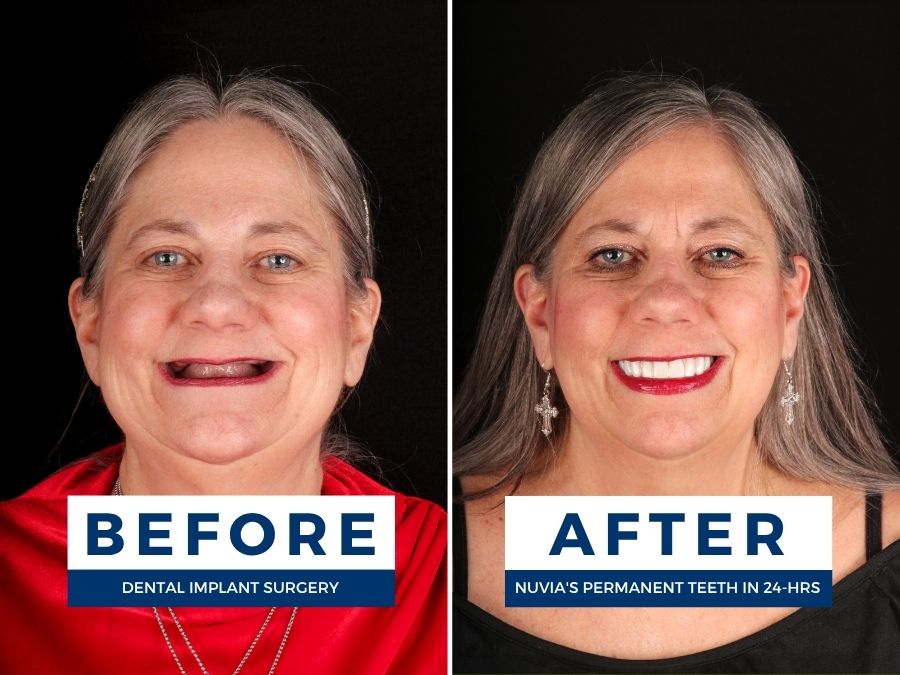
Here’s what a real patient who has had both dentures and dental implants has to say about her experience and what she would have done differently.
**Actual NUVIA patient(s) who may have been compensated for sharing their story. Not all those who come in for a consultation are eligible for this treatment. Results may vary in individual cases.
The Hidden Costs of Dentures That Nobody Talks About Up Front
Dentures are not typically a one-time purchase. They can often require regular relining, adjustments, and in many cases full replacements over time.
Relines alone can run several hundred dollars per visit, and they're usually not optional — as your jaw changes shape (more on that shortly), the fit of your denture changes with it.
Add in the cost of adhesives, cleaning products, and the occasional emergency visit when a sore develops or a denture cracks, and the true cost of dentures can begin to compound steadily year after year.
Beyond the out-of-pocket expenses, there's the time cost.
Every adjustment, every reline, every follow-up is another appointment — more time off work, more scheduling, more of your life organized around a dental problem you thought you'd already solved.
The hidden costs of dentures aren't always financial. Sometimes they show up as frustration, inconvenience, and the creeping realization that you've simply traded one set of dental problems for another.
Bone Loss: The Cost You Can't Pay Your Way Out Of
This is the part of the denture conversation that most people don’t hear until it's too late. When your natural teeth are removed and replaced with a removable denture, your jawbone no longer receives the stimulation it needs to maintain its bone levels.
Over time — sometimes within just a few years — the bone is likely to begin shrinking. This is called resorption, and it's not reversible.
The financial and medical consequences of bone loss are significant. As the bone shrinks, your denture is highly likely to fit worse, which means you’ll probably find yourself needing more relines and replacements.
Oftentimes with bone loss, your facial structure changes. And if you eventually decide you want a final fix to dental issues by getting dental implants — which require the bone to be anchored into — you may find that the window has closed.
Patients with severe bone loss are sometimes turned away as implant candidates entirely, regardless of their budget.
That being said, highly skilled oral surgeons who do dental implants day in and day out may still be able to help patients with extreme bone loss. Zygomatic and other advanced methods may mean there is still hope.
Even if you’ve been turned away elsewhere it doesn’t hurt to see if you may still be eligible for full mouth dental implants with the 60-second quiz. Nuvia’s oral surgeons and restorative doctors do these type of procedures all day every day and often take patients who have been turned away elsewhere.
Bone loss is one of the most important reasons that "I'll just get dentures for now and upgrade to implants later" is a riskier plan than it sounds. The clock starts the moment the teeth come out. If implants are something you've ever considered, the time to act is before bone loss has progressed — not after.
%20(6).jpg)
The Real Cost Comparison Over Time
When you look at the numbers side by side over a 20-year window, the upfront savings of dentures tend to disappear. The table below outlines a realistic comparison of what each option typically costs across a patient's life, factoring in ongoing maintenance, replacements, and associated dental care.
*It’s also important to note that this table does not factor in quality of life costs or average satisfaction rates. For more details on that, read about why Dan switched to permanent teeth with dental implants after only 6 months of wearing a denture.
No two patients are exactly alike, and exact costs vary based on location, provider, and individual treatment needs.
But the pattern holds across the board: dentures appear cheaper because the costs are spread out and easy to underestimate, while dental implants appear expensive because the cost is often discussed as one large lump sum.
Over a full lifetime, the gap between the two closes — and in many cases reverses. It’s also important to note that while the cost of dental implants is largely all upfront, dental implant financing means that you don’t have to pay it all at once.
In fact, about 92% of Nuvia patients use financing to restore their smile right away—allowing them to avoid further bone loss and start living life without the limitations their teeth once caused.
What "One and Done" Actually Means Financially
One of the most overlooked financial advantages of dental implants is their predictability and durability. At Nuvia, once the implants are placed and the permanent teeth are delivered (24 hours later), there are no surprise bills.
You aren’t going to need to worry about emergency dental visits because a tooth chipped at dinner. No abscesses, no root canals, no crowns — because the implants themselves are titanium posts anchored into your bone, and the teeth attached to them don't decay.
Routine checkups and cleanings are still part of the picture, but the unpredictable, open-ended dental spending that defined life before implants simply stops.
For patients who have spent years budgeting around the next dental crisis, that kind of financial stability can be genuinely life-changing.
Questions Worth Asking Before You Decide
If you're weighing your options, here are the most important questions to get answered before committing to either dental implants or dentures:
- How is my bone density right now? If you're considering implants at any point in the future, getting your bone assessed today is critical. Waiting too long can mean losing eligibility entirely.
- What is the realistic total cost of dentures over the next 10–20 years, including relines, replacements, and any associated dental visits — not just the day-one price? It’s important to ask yourself if you could realistically live in a denture for the next 10-20 years.
- Are financing options available that could make implants more accessible upfront, spreading the cost in a way that changes the month-to-month math? At Nuvia, the answer is yes for qualifying patients.
- What does my current dental spending look like annually, and how much of that would go away with a permanent solution?
The answers to those questions have a way of making the decision a lot clearer — and the best time to get them is before bone loss makes the choice for you.
Find out if you may be a candidate — It only takes 60 seconds
Every day you wait is a day your bone health could be changing. Take the quick quiz now to see if permanent teeth in 24 hours might be an option for you.




.jpg)
.jpg)