


If you’re missing teeth, the decision you make next matters more than most people realize. Not just for how your smile looks — but for how you eat, how your jawbone holds up over time, and whether you’ll be dealing with the same problem again a few years from now.
A lot of people are told that dentures with implants are the “best of both worlds.” Somewhat more stable than dentures. Potentially less complex than permanent implants. Sounds like a middle of the road solution, right?
But here’s what rarely gets explained clearly: why some options work short term but fall short long term — and how two solutions that sound similar can lead to very different outcomes for your comfort, confidence, and bone health.
Before you commit to anything permanent (or semi-permanent), it’s worth slowing down and understanding what each option actually does — and what it doesn’t.
.jpg)
Options For Replacing Your Teeth
When teeth are missing, there are a few main paths dentists typically talk through. Each one solves a different problem, and none of them are interchangeable — even though they’re often discussed that way.
Most patients will hear about:
- Traditional removable dentures
- Dental bridges
- Dentures with implants (also called implant-supported dentures or overdentures)
- Fixed full-arch dental implants
On paper, they may seem like small variations. In real life, the differences often show up when you’re eating, speaking, cleaning your teeth, and living with the result day after day.
Denture With Dental Implants: The Overdenture or Implant-Supported Denture
If you’ve ever been to a denture consultation, you may have been surprised by how many versions of “dentures” there actually are. One option that often comes up is dentures with implants, commonly called an implant-supported denture or overdenture.
This option looks similar to a traditional denture, but instead of relying only on the gums for support, dental implants are placed into the jawbone. The denture then snaps onto those implants, which helps keep it more secure.
Compared to traditional dentures, dentures with implants are noticeably more stable. Most patients can generate about fifty to sixty-five percent of their natural biting force, which can make eating feel more like it would with natural, healthy teeth.
That said, this is still a removable appliance. It needs to be taken out to clean, and the snap-in components can wear down over time. Maintenance and occasional replacement of parts is part of the long-term reality.
For some people, dentures with implants can feel like a reasonable middle ground — more stable than dentures, but still removable.
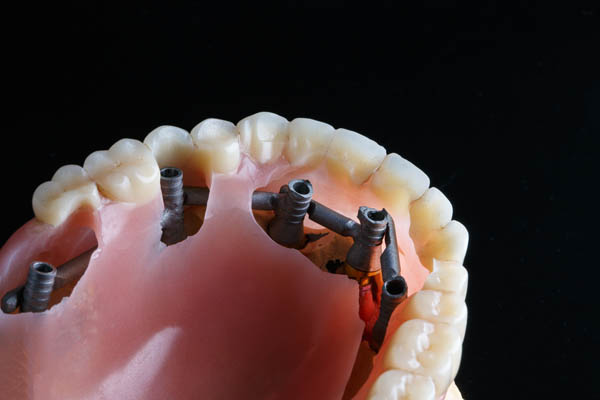
Dental Implant Supported Bridges
Dental implant supported bridges are usually recommended when someone is missing one or a few teeth, not an entire arch. The bridge is anchored to implants or neighboring teeth and stays in place.
They can work well in specific situations, but they’re not designed to replace a full smile or address widespread tooth loss.
Dentures and Bone Loss
One of the most important things to understand about dentures — and something many people aren’t told clearly — is how they affect the jawbone.
Natural teeth have roots. Every time you chew, those roots stimulate the jawbone and help keep it strong. When teeth are missing and nothing replaces those roots, the bone no longer gets that stimulation. Over time, it begins to shrink.
This is why dentures often loosen as time goes by, why facial structure can change, and why people who wait too long sometimes find they have fewer options later.
Dental Implants Help Prevent Bone Loss
Dental implants act like artificial tooth roots. When implants are placed into the jawbone, they provide stimulation during chewing that can help slow further bone loss in those areas.
With dentures supported by dental implants, this added support can improve stability and comfort. However, stimulation only occurs where implants are placed, meaning areas without implants may still experience bone loss over time. This is one key difference between removable implant-supported dentures and fixed full-arch implant solutions.
Here’s a simple way to compare how these options function:
Does Nuvia Do Dentures?
Nuvia Dental Implant Centers focus specifically on fixed, full-arch dental implants designed to provide a permanent solution for widespread tooth loss. Consultations at Nuvia are centered on determining whether a fixed full-arch approach is the right fit for your long-term goals.
What if You Want the Highest Quality Replacement Teeth Available?
If your goal is teeth that feel solid, don’t move, and function as close to natural teeth as possible, this is where fixed full-arch dental implants come in.
Unlike dentures with implants, fixed dental implants are not removable. A full bridge of teeth is securely attached to multiple implants placed in the jawbone, allowing chewing forces to be spread evenly and efficiently. For most patients, this translates to better comfort, stronger bite force, and fewer long-term compromises.
Other providers will often advertise “teeth in a day®” when offering full mouth dental implants. While this may sound like everything is done all in one day, the truth is that the teeth patients get with “teeth in a day®” usually refers to a temporary set of healing teeth – not their permanent set.
Depending on the provider it may take up to 10+ months before the permanent teeth are ready. This is not the experience at Nuvia.
You can get your permanent set of teeth in just 24 hours at Nuvia. The process is designed to deliver permanent teeth just 24 hours after implant surgery — not temporary ones. After implants are placed, your mouth is digitally scanned, and an in-house lab works overnight to create your final teeth, getting rid of months of waiting and unnecessary extra appointments that take time away from work, family, and other priorities.
Permanent Teeth in 24 Hours Cost
A lot of people assume dental implants — especially permanent teeth in 24 hours — must cost far more than dentures or other denture-related solutions.
What often gets overlooked is that dental implants are designed to last a lifetime with proper care, while temporary solutions like dentures usually need to be replaced, adjusted, or repaired every few years — costs that can add up over time.
And while insurance rarely covers dental implants, that doesn’t mean they’re out of reach. In fact, 92% of Nuvia patients use financing plans to make dental implants affordable by spreading the cost into manageable monthly payments.
If you’re ready for a dental solution that’s made to last, see if you may be a candidate for permanent teeth in 24 hours with this 60-second quiz.




.jpg)
.jpg)

.jpg)