

Why Replacing Missing Teeth Matters
Missing teeth affect far more than your smile — they can change the way you chew, speak, and even the shape of your face. When teeth are gone, the jawbone beneath begins to shrink, causing the cheeks to sink and age the face faster than you might expect.
Even more serious, studies link missing teeth and gum disease to higher risks of heart disease, stroke, and other long-term health issues.
Replacing missing teeth isn’t just cosmetic — it’s a major step toward protecting your health and restoring your confidence. It keeps your bite strong so you can eat the foods you love again.
Most people turn to dentures or dental implants for a solution — but only one truly prevents bone loss and helps you reclaim your smile for good.
The Procedure: How They’re Made and Placed
Dental Implants
Dental implants act like new tooth roots. If you’re at Nuvia, an oral & maxillofacial surgeon places small titanium posts into the jawbone. Elsewhere a general dentist may be doing this.
The bone naturally grows around the posts, similar to how it would around tooth roots. A full set of zirconia teeth is then attached to the post. At Nuvia you get your teeth in 24 hours, elsewhere it could be up to 10+ months.
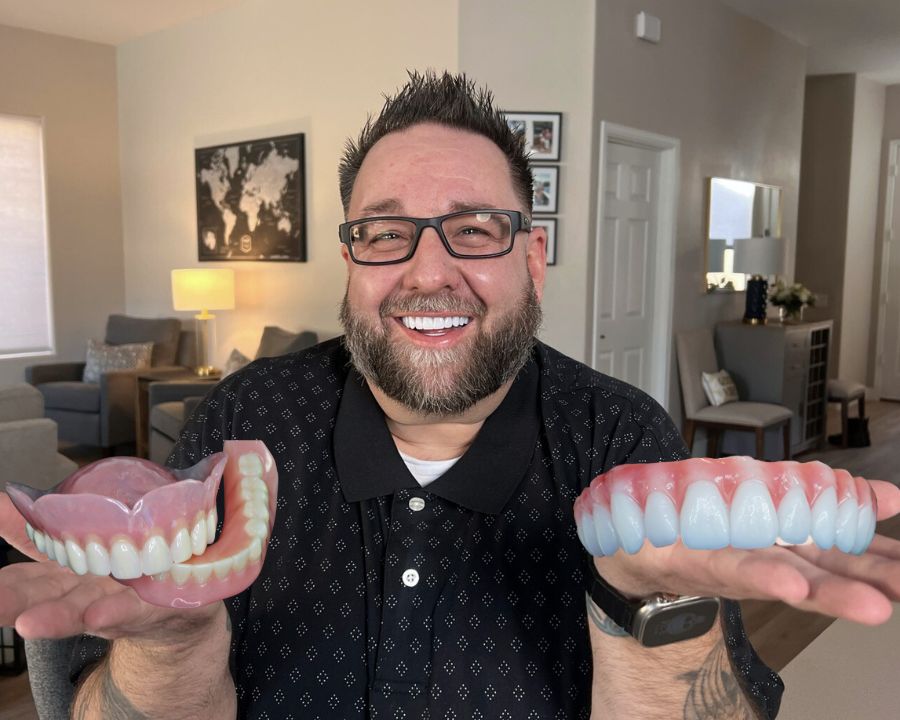
Dental implants can replace a single tooth, several teeth, or a full mouth. Because they are fixed in place, you don’t remove them — they function like real teeth. However, if you’re weighing out dental implants vs dentures, it’s likely you could be a candidate for full mouth dental implants.
Take the 60-second quiz to see if you may be eligible.
Dentures
Dentures are removable sets of teeth that sit on top of your gums. They don’t require surgery and can be made even if you’ve lost a lot of bone.
A dentist takes molds of your mouth to make dentures that fit your gums. Sometimes, several fittings are needed before they feel right. Dentures can replace all the teeth on your top, bottom, or both arches. You take them out at night to clean and soak them.
Unlike dental implants, they aren’t designed to be a permanent solution and patients often find that although they’re a step up from missing teeth, they come with plenty of drawbacks of their own. More on that later.
Cost: Short-Term vs. Long-Term Investment
Dentures often seem cheaper upfront — but the savings don’t last. They wear out, loosen, and break, requiring ongoing adjustments and frequent replacements. Add in adhesives, cleaners, and daily maintenance, and the costs quietly pile up year after year.
Dental implants are a bigger initial investment, but they’re built to last a lifetime with proper care. At Nuvia, pricing is transparent and all-inclusive — anesthesia, surgery, and your permanent zirconia teeth are all covered in one straightforward price. No surprises, no hidden fees.
And you don’t have to pay for everything at once. Many patients choose flexible monthly payment plans that make permanent teeth both achievable and affordable — a lifetime solution instead of a temporary fix.
For a more detailed breakdown of cost, see the dental implant cost guide here.
Maintenance: Daily Care and Upkeep
Dental Implants
Taking care of dental implants is almost the same as caring for natural teeth. You brush twice a day, floss, waterpik, and visit your dentist for cleanings. Zirconia teeth resist stains and don’t decay, so care is simple.
Dentures
Dentures require more daily work. You remove them to clean after meals and must soak them overnight. Adhesive can build up, and food may get stuck underneath. Over time, your jaw shape is likely to change without any team to keep it strong, meaning the dentures will need to be adjusted or remade.
Comfort and Feel
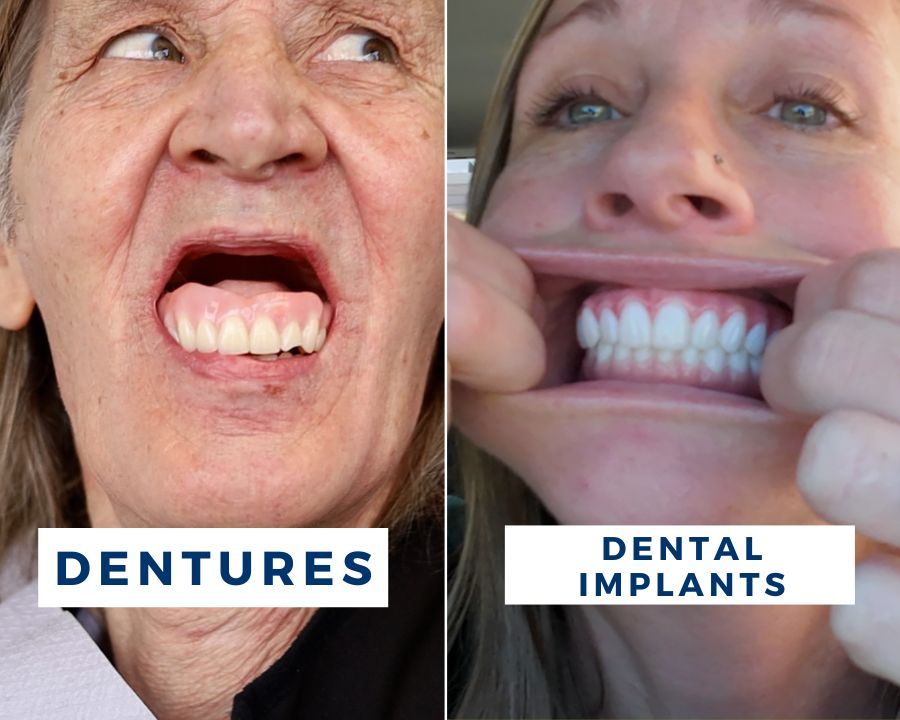
One of the biggest differences between permanent teeth with dental implants and dentures is how they feel in everyday life.
Implants with zirconia teeth are secure, natural-feeling, and don’t move. Once healed, you can bite into foods like apples or steak with full confidence. Because implants stimulate the jawbone, they also help preserve facial structure — preventing the sunken look that develops as bone fades away.
Dentures, on the other hand, can slip, rub, or feel bulky over time. Many people struggle with looseness, difficulty speaking, or even a dull sense of taste from the upper denture covering the roof of the mouth.
If comfort, stability, and real function matter most to you, dental implants with permanent teeth are what can get you a smile that feels like your own again.
Complications and Common Issues
Both options are safe when done properly, but they come with different risks.
- With dentures: soreness, slipping, or mouth irritation are common, especially when they don’t fit snugly.
- With implants & zirconia teeth failure is rare but possible if bone quality is poor or healing instructions aren’t followed.
At Nuvia, every case is handled by board-certified oral surgeons and restorative doctors who do full-mouth implants every single day — not as a side service, but as their primary focus.
In fact, many patients come to Nuvia after failed or “botched” dental implants elsewhere — and finally get the permanent, confident smile they were promised.
Bone Health and Candidacy
Dental implants need a strong, healthy jawbone to hold the posts in place. If too much bone has been lost, a bone graft might be needed — though advanced techniques like All-on-4® and zygomatic implants often make that unnecessary.
Dentures don’t rely on bone for support, which is why they can still be used even when the jawbone has shrunk. However, dentures do nothing to stop that bone loss. Without the stimulation that natural teeth or implants provide, the bone beneath the gums continues to weaken and shrink year after year.
That’s where timing becomes critical. Once that bone disappears, it’s gone for good. Every month you wait, your jaw is likely to literally shrink a little more — making future implant treatment harder, more expensive, and in some cases, impossible without major bone grafting.
The longer you wait, the fewer options you have. But patients who act early often avoid bone grafts entirely — saving months of treatment and thousands in added cost. They also protect their facial shape and strength, preventing that “sunken” look that can come from years of bone loss.
If you’re considering dental implants, the best time to protect your bone is before it’s gone. Every day you delay, you’re putting a new permanent smile at risk.
See if you may be a candidate for permanent teeth in 24 hours with the 60-second quiz.
Making the Decision
Here’s a simple breakdown:
When choosing, think about:
- Your age and overall health
- How important comfort and long-term value are to you
- Whether you prefer something fixed or removable
- How much time you’re willing to spend on daily care
Alternatives Worth Knowing
Some people choose snap-in dentures or implant-supported bridges — hybrid options that can sound appealing at first glance. Snap-in dentures use 2–4 implants as anchors but still need to be removed for cleaning. Bridges use nearby teeth for support when replacing a small gap.
While these solutions can work for some, it’s important to understand what you give up. Snap-ins and bridges may feel like shortcuts, but they don’t provide the same stability, chewing power, or long-term bone protection that full mouth dental implants do.
And here’s the part most patients don’t realize: every year you stay with a removable option, your jawbone continues to shrink. Once that bone is gone, no “upgrade” to permanent implants can bring it back without complex grafting — or, for some, at all.
So, if you’re considering these “in-between” choices, think of them as temporary solutions, not forever fixes.
The Takeaway
Dentures and dental implants both give back your smile — but they do it in very different ways.
- Dentures may seem quick and affordable, but they’re removable, less stable, and can’t stop bone loss.
- Dental implants are strong, natural-feeling, and protect your bone and facial shape for life.
If you’re ready for a permanent solution that looks, feels, and functions like real teeth, dental implants are the clear choice.
At Nuvia Dental Implant Center, patients receive their custom zirconia permanent teeth in just 24 hours — with transparent, all-inclusive pricing and no hidden fees.
Don’t wait while bone loss continues. Take the 60-second quiz to see if you may be eligible for a new, permanent smile..




.jpg)