
What Are Zirconia and Acrylic Teeth?
When people get full-mouth dental implants, they need a set of new teeth that attach to the implants. These teeth can be made from different materials, acrylic and zirconia being very common.
- Acrylic teeth are made from a type of plastic. They’re lightweight and easier to make quickly, but they can wear down or break over time. They are not typically designed to be a permanent solution.
- Zirconia teeth are made from zirconium dioxide, a high-strength ceramic that’s been used safely in dentistry and medicine for many years. It’s incredibly hard and durable—more like real enamel. It is considered a “final” material because it is meant to be used as a permanent solution.
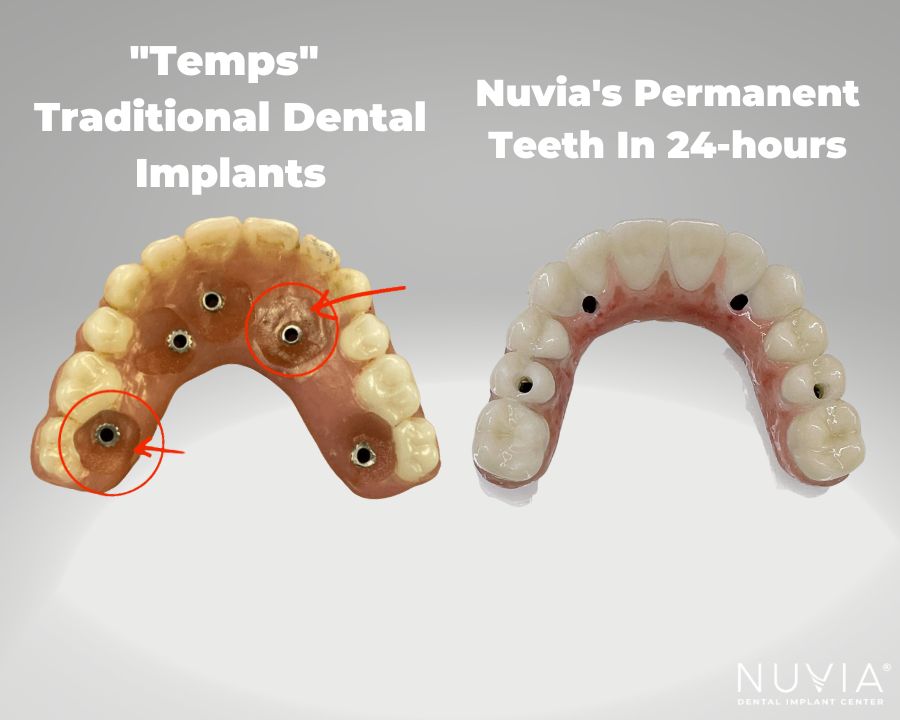
The traditional approach to full mouth dental implants typically involves placing the implants and giving a patient a non-custom, temporary set of teeth made from acrylic. Patients can wear these for up to 10+ months before getting their final teeth.
During this time it is not uncommon for acrylic teeth to break, potentially disrupting the healing process.
The good news is that even though many providers are still using this outdated, traditional approach, that doesn’t have to be your experience.
Instead, you can get your permanent zirconia teeth just 24 hours after your dental implants are placed. We’ll cover more on that process later, but for now, here is why you probably want to start with a zirconia set of teeth vs acrylic teeth.
Durability: Strength You Can Count On
The biggest difference between zirconia and acrylic teeth is strength.
Scientific studies show that zirconia has a flexural strength between 900–1200 MPa (megapascals), while acrylic averages only 101 MPa【PMC6872834, PMC4606640】.
In simple terms, zirconia can handle normal chewing forces and even biting hard foods without cracking, while acrylic can bend, chip, or break much more easily.
That strength also means zirconia teeth stay smooth and don’t scratch or trap bacteria as easily as acrylic might. Scratches on acrylic can collect plaque, which may lead to gum inflammation or odor over time.
If you or anyone you know has acrylic dentures, you may be familiar with how they must be removed to be cleaned. Zirconia teeth fixed with dental implants can be brushed like natural teeth.
Because zirconia is so strong, it’s possible to safely place permanent zirconia teeth within 24 hours after implant surgery. This can potentially aid in the healing process as it protects your new dental implants from any micromovements.
They also aren’t as likely to break like a temporary set of acrylic teeth might (it’s super important that your teeth don’t break while your mouth is trying to heal!)
What Zirconia and Acrylic Teeth Feel Like?
Acrylic teeth can feel “light” or “plastic-like.” They can also make clicking sounds when chewing and often have a thicker base to keep them from cracking. Many patients say they can tell the difference when they bite into food—acrylic just doesn’t feel quite like natural teeth.
Zirconia, on the other hand, feels solid and stable. It’s denser and quieter when chewing, more like natural enamel. A final set of zirconia teeth are custom-fitted through digital design, so they don’t feel bulky or unnatural like a temporary, un-customized set of acrylic teeth might. Patients often say they forget they even have implants after a few weeks.
**Actual NUVIA patient(s) who may have been compensated for sharing their story. Not all those who come in for a consultation are eligible for this treatment. Results may vary in individual cases.
Aesthetics: The Look of a Real Smile
Acrylic teeth can look nice at first, but over time they may stain, dull, or discolor, especially from coffee, wine, or smoking. The plastic surface can also wear down, flattening the edges of the teeth.
Zirconia teeth keep their color and shine for decades. The material reflects light like natural enamel, which makes the smile look more lifelike. Each set is digitally designed for shape, shade, and alignment to fit the patient’s face perfectly.
Zirconia’s smooth surface also resists plaque and buildup, which helps keep the gums healthy and the smile bright.
Teeth-in-a-Day vs Permanent Teeth in 24 Hours
Here’s where the biggest difference between zirconia and acrylic teeth shows up—how and when patients get their final teeth.
In traditional systems, the acrylic “healing teeth” are meant to protect the implants while the bone heals and give patients a makeshift set of teeth to use. But because acrylic is weak, patients may be limited to liquid only diets for months.
Nuvia’s system uses zirconia instead, which is strong enough and safe enough to allow a soft food diet right away, without the risk of breaking a temporary set of teeth.
Why Zirconia Is Safe to Use in 24 Hours
Giving patients their permanent teeth right away is as safe as giving patients a temporary set - and may even have some benefits during the healing process as well.
Research supports zirconia’s use for long-term, full-arch bridges. A 2019 review in the Journal of Prosthodontics found zirconia restorations to have survival rates above 99% over several years of follow-up【Pjetursson BE et al., Clin Oral Implants Res. 2012】【Miyazaki T, Hotta Y. Dent Mater J. 2011.
Because the implants are stable and the teeth are rigid, patients can safely receive their permanent zirconia bridge within 24 hours instead of waiting months.
What else contributes to patients safely getting a new smile at Nuvia? Here are a few factors:
- Provider experience is a key part of having the procedure done safely. Each patient is cared for by an expert team that includes highly experienced oral surgeons, restorative dentists, and CRNAs. At Nuvia, full mouth dental implants is what the team does day in and day out. If anyone is an expert when it comes to smile restorations, it’s the team at Nuvia.
- Precise 3D planning: Digital scans and 3D imaging help plan each implant’s exact position before surgery.
- Custom-fit design: The new zirconia teeth are made custom for your mouth for a comfortable, natural fit.
- Material strength: Zirconia is much stronger than plastic teeth (acrylic), so it won’t bend or wear out easily.
- One location for everything: Surgery, design, and placement all happen under one roof — no bouncing between offices.
- Close follow-up care: The team checks healing and bite comfort to make sure everything stays stable.
How Much Do New, Zirconia Teeth Cost?
Whether you get your zirconia teeth in 24 hours at Nuvia or go the traditional route and deal with the hassle of temporary teeth for months before getting zirconia teeth - you probably want to know how much they are going to cost.
Costs and pricing structures will vary from provider to provider but at Nuvia, your investment in yourself is all inclusive. No hidden fees, no surprise bills. What you’re told is what it will be - and it covers the whole process.
For more on cost breakdown, see the dental implant cost guide here.
Which Material Is Right for You?
If you want a fast, lasting, and natural-looking result, zirconia is the clear solution.
It’s stronger, more hygienic, and doesn’t require you to live months with fragile temporary teeth.
Acrylic can serve a purpose for short-term healing or single-tooth solutions, but it’s not designed for permanent, full-arch restorations.
And if you go to a reputable provider, you’ll likely get a final material like zirconia for your new smile… The only question is how long will that take? With other providers, it could be up to 10+ months.
But at Nuvia, you can get your new, zirconia smile 24 hours after surgery. It’s a one-time procedure designed to provide a lifetime of comfort and function.
See if you may be a candidate for permanent teeth in 24 hours with the 60-second quiz
Sources
- U.S. National Library of Medicine. Comparison of flexural strength in three types of denture base resins https://pmc.ncbi.nlm.nih.gov/articles/PMC4606640
- U.S. National Library of Medicine. Flexural Strength of Zirconia vs Acrylic. PMC6872834




.jpg)


.jpg)